Healthcare VA vs Front Desk Hire: What Each Really Costs
A transparent cost model for practice owners: what an in-house front desk really costs once benefits, leave, equipment and turnover are counted, what a healthcare VA costs, and where each option falls short.

Joshua is an SEO and digital marketing specialist at Nomad VAs, where he manages local and national SEO, on-page optimization and content, and writes on delegation and remote hiring.
Key takeaways
- The BLS reports a median hourly wage of $22.08 for medical secretaries and administrative assistants (May 2025), about $45,900 a year before any on-costs.
- Benefits are 30.0 percent of private employer compensation costs (BLS, June 2026), so one front desk hire costs about $65,600 before equipment, leave gaps or turnover.
- Our base case totals about $72,100 in-house against about $22,300 for a full-time healthcare VA: a gap of roughly $49,800 a year, or 69 percent.
- One in-house hire covers about 74 percent of a 50-hour clinic week once leave is removed, so the cheapest plan is often a hybrid.
- A VA cannot greet patients or handle the counter. Keep a lobby role if your visits need one.
- HIPAA adds cost to both options. Any VA who sees patient data needs a business associate agreement first.
Most practice owners start a healthcare VA vs front desk hire comparison with the hourly wage, and that is the number that misleads most. A $22 hour becomes a $72,000 year once payroll taxes, benefits, paid leave, equipment and turnover are added. This guide builds the full cost line by line, shows what a healthcare VA engagement costs in the same terms, and says plainly where a VA is the wrong tool. Every figure is dated and every assumption is labelled.
What does an in-house front desk hire really cost?
A median-wage front desk hire costs about $72,100 a year in our base case, or roughly $6,000 a month, once on-costs are added to the $45,900 wage. The wage is the smallest surprise. The larger part is everything the payroll line does not show.
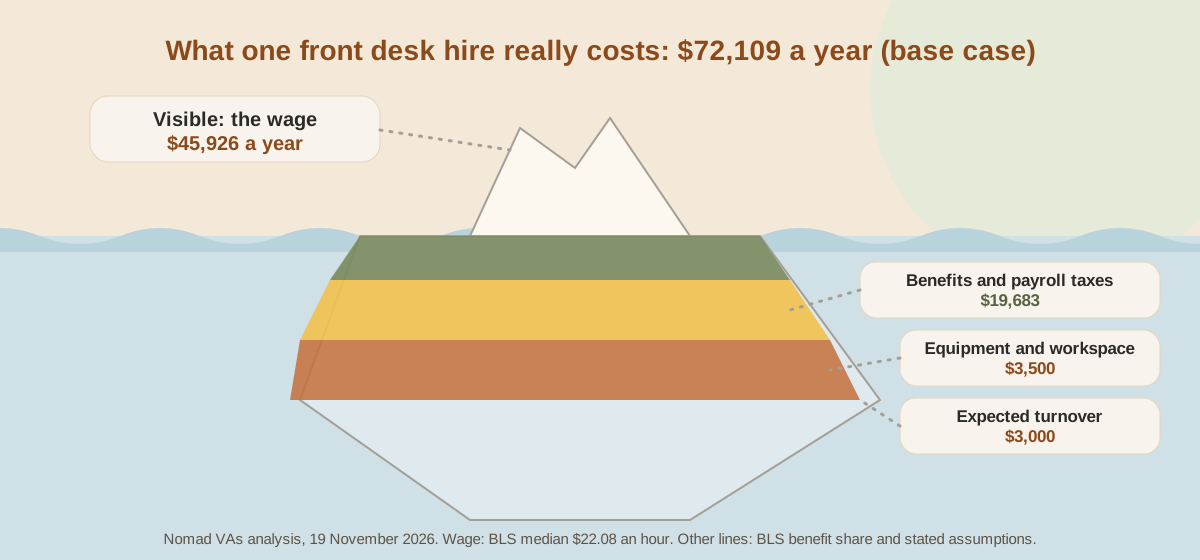
The wage comes from the Bureau of Labor Statistics, which reports a median hourly wage of $22.08 and a mean annual wage of $46,800 for medical secretaries and administrative assistants in May 2025, across 961,610 jobs. The benefit load comes from the BLS Employer Costs for Employee Compensation release, which finds that benefits are 30.0 percent of compensation for private industry (June 2026).
Table 1: Original data: annual cost of one full-time in-house front desk hire versus one full-time healthcare VA
| Line item | Low | Base | High |
|---|---|---|---|
| Wage at median ($22.08 x 2,080 hours) | $45,926 | $45,926 | $45,926 |
| Payroll taxes and benefits (30.0% of total pay) | $19,683 | $19,683 | $19,683 |
| Equipment, software seat and workspace (assumption) | $2,000 | $3,500 | $5,000 |
| Expected turnover cost (assumed rate x replacement cost) | $1,200 | $3,000 | $6,000 |
| In-house total | $68,809 | $72,109 | $76,609 |
| Healthcare VA, 40 hours a week, billed on hours worked | $18,720 | $20,800 | $22,880 |
| Client-side cost: EHR seat and compliance training (assumption) | $1,000 | $1,500 | $2,000 |
| VA total | $19,720 | $22,300 | $24,880 |
| Annual gap and share saved | $49,089 (71%) | $49,809 (69%) | $51,729 (68%) |
Source: Nomad VAs analysis, 19 November 2026. Wage and benefit share: BLS. Equipment, turnover and VA client-side costs are stated assumptions. The VA is priced at $9, $10 and $11 an hour for Low, Base and High.
Healthcare VA vs front desk hire: how big is the gap?
The gap in our base case is about $49,800 a year, or 69 percent, and it stays between 68 and 71 percent across all three scenarios. The result is stable because the two largest inputs, the wage and the benefit load, come from public BLS data. Only the smaller lines move.
The VA side is simple because it is billed on hours worked. Nomad VAs publishes an estimate of $9 to $11 an hour depending on role, with 20-hour and 40-hour weekly packages, and confirms the rate in writing after a discovery call. At 40 hours a week that is $18,720 to $22,880 a year, with no paid leave, benefits or equipment line. See our pricing for how the packages work.
The same year, two ways
Tap a row to compare a full-time healthcare VA with one in-house front desk hire, from Table 1.
Tap a row to compare.
Figure 2: Annual cost of a healthcare VA and one in-house front desk hire in the low, base and high cases. Source: Nomad VAs analysis, 19 November 2026.
The VA total also carries costs you still pay. Your EHR may charge per user seat, a VA needs HIPAA training from you, and someone on your team must hand off tasks and review the work. We assumed $1,000 to $2,000 a year for seats and training. We did not price your manager's time, so add an hour or two a week if you want the fully loaded view.
What hidden costs exist in-house?
Hidden costs are the lines that never appear in the offer letter: leave, on-costs, turnover, equipment and coverage you buy again when the front desk is empty. Owners who compare hourly wage only understate the in-house side by about $26,200 a year in our base case.
Table 2: Where each cost lands, in-house versus a healthcare VA
| Cost line | In-house front desk | Healthcare VA |
|---|---|---|
| Payroll taxes and benefits | 30.0% of total pay, about $19,700 on the median wage | Not applicable; billed rate only |
| Paid leave and holidays | 21 paid days assumed, 168 hours, so 1,912 productive hours of 2,080 | Billed on hours actually worked |
| Equipment, seat and workspace | $2,000 to $5,000 assumed | VA laptop and internet in the rate; EHR seat is yours |
| Turnover and vacancy | $1,200 to $6,000 expected per year in our scenarios, plus a gap while you hire | Free replacement in the first month; later changes are a handoff, not a rehire |
| Recruiting and training | Posting, interviews, weeks of ramp time | Pre-vetted match; you supply procedures and access |
| Management time | Daily, in person | Weekly check-ins plus written procedures |
| Coverage gaps | Absence leaves the desk uncovered or needs overtime | Hours flex to your needs, set in the written quote |
Source: Nomad VAs analysis, November 2026. Benefit share: BLS ECEC, June 2026. Leave days, equipment and turnover are assumptions. Confirm the VA tool split in your written quote.
Turnover is real, but be careful with the figures you see
Front office turnover is a common complaint in practice management, and a vacancy at the desk hits scheduling, collections and patient calls first. Be wary of the vendor blogs that put a replacement cost on it. We found no neutral benchmark, which is why our model shows three labelled scenarios instead of one confident number. If you have your own turnover history, use it in place of ours.
How do coverage gaps change the math?
One in-house hire covers about 74 percent of a 50-hour clinic week, so many practices that think they have a full front desk are short for a quarter of their open hours. A clinic open 50 hours a week is open 2,600 hours a year. One employee who works 2,080 hours and takes 168 hours of paid leave covers 1,912 of them.
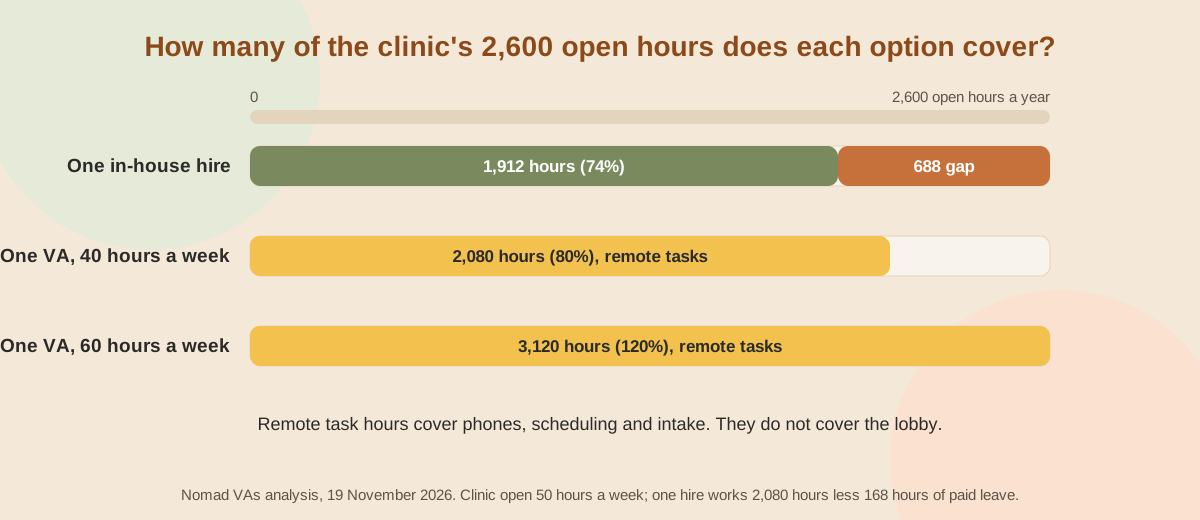
Table 3: Original data: four staffing options for a three-provider clinic open 50 hours a week (2,600 hours a year)
| Option | Annual cost | In-person hours covered | Remote task hours covered |
|---|---|---|---|
| A. One in-house hire, full time | $72,109 | 1,912 (74%) | 1,912 |
| B. One healthcare VA, 40 hours a week | $22,300 | 0 | 2,080 (80%) |
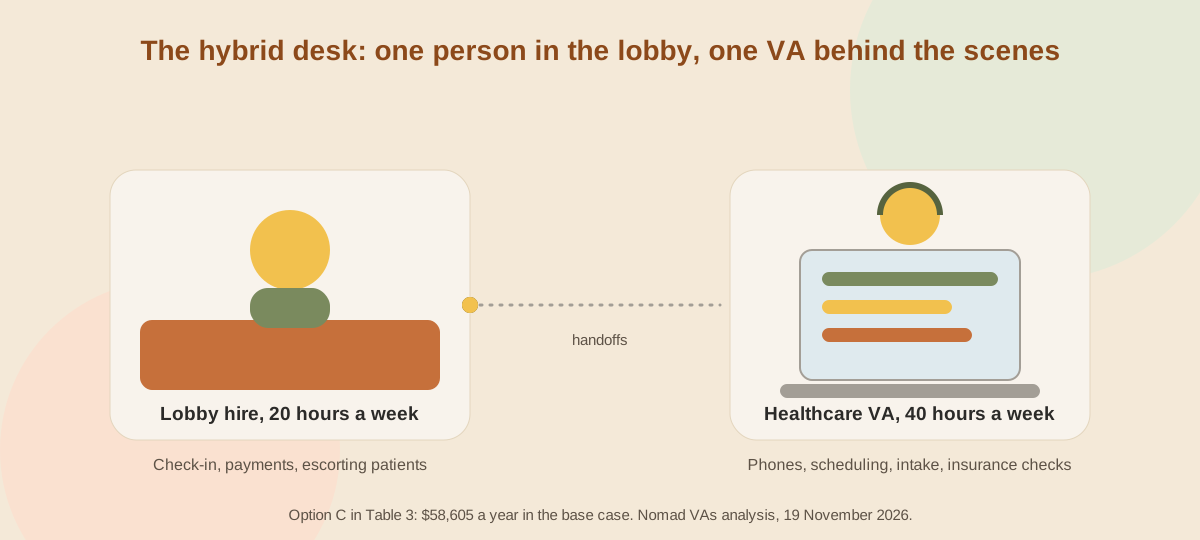
| C. Part-time lobby hire plus VA, 40 hours | $58,605 | 1,040 (40%) | 3,120 total |
| D. One healthcare VA, 60 hours a week | $33,200 | 0 | 3,120 (120%) |
Source: Nomad VAs analysis, 19 November 2026. VA at $10 an hour plus $1,500 client-side costs; the part-time hire works 20 hours a week on the same on-cost basis.
Option C is the safe middle for most clinics: a person at the counter for check-in and a VA behind them for everything that does not need a body in the lobby. Option D suits practices with a small in-person footprint, such as telehealth-heavy or appointment-only specialists. Healthcare VAs at Nomad VAs log in when the practice needs them, so early appointments, late sessions and extended phone hours can be written into the quote.
Can a healthcare VA replace a front desk?
A healthcare VA can replace the remote half of the front desk, not the physical half. Anything done on a phone, a screen or in your scheduling system can move. Anything done face to face stays with your team.
Table 4: Front desk tasks by who can own them
| Task | Healthcare VA | In-person hire |
|---|---|---|
| Appointment scheduling, reschedules and reminders | Yes | Yes |
| Patient intake forms and chart prep | Yes | Yes |
| Insurance verification and prior authorizations | Yes | Yes |
| Phone calls and inbox triage | Yes | Yes |
| Billing follow-up and claim status | Yes, within your policies | Yes |
| Greeting and checking in patients | No | Yes |
| Taking payments at the counter | No | Yes |
| Vitals, rooming and clinical judgment | No | Clinical staff only |
Source: Nomad VAs analysis; task examples drawn from the healthcare VA role.
Our guides on patient intake and scheduling and on what a healthcare virtual assistant does cover these tasks in more detail, and setting up scheduling workflows shows how to hand them over cleanly.
When is a healthcare VA not the right choice?
A healthcare VA is the wrong choice when most of the front desk job is physical, when you cannot give access to your systems, or when you have no written procedures to hand over. Say so early, because a poor match wastes more than it saves.
- A busy walk-in lobby. If most of the day is greeting, payments and directing people, you need a person on site.
- No procedures yet. A VA follows documented steps. If the work lives in one person's head, write it down first.
- No appetite for access controls. If you will not set up unique logins, multi-factor sign-in and a business associate agreement, do not give a VA patient data.
- A single clinician with very low volume. At a few hours of admin a week, a part-time VA package is likely enough and a full front desk hire is too much.
- Clinical work. A VA does not triage symptoms or give medical advice.
What does HIPAA add to the cost on either side?
HIPAA adds roughly the same compliance work to either option, because anyone who sees protected health information needs training, access controls and a clear agreement. The difference is the paperwork: a front desk employee is your workforce, while a VA engaged through an outside provider is typically a business associate.
Table 5: HIPAA-related cost lines for each option (general information, not legal advice)
| Cost line | In-house front desk | Healthcare VA |
|---|---|---|
| Agreement | Workforce policies and confidentiality terms | Written business associate agreement before access |
| Training | Required workforce security training | Same training, delivered by you |
| Access control | Unique logins, role-based access | Same, plus multi-factor sign-in on remote access |
| Offboarding | Remove access on exit | Remove access on exit; easier to audit if logins are individual |
| Responsibility | Practice | Practice makes sure the agreement and safeguards are in place before access |
Dollar figures are not modeled except the VA client-side assumption in Table 1. Confirm what applies to your practice with your compliance advisor or counsel.
HHS publishes sample business associate contract provisions that your advisor can adapt. Ask any provider, including us, how a business associate agreement is handled and how access is controlled and removed. Our vetting and onboarding process explains what we do before a VA starts. Compliance review is part of publishing this guide, and your own advisor should confirm what applies to your practice. Our list of questions to ask before outsourcing medical admin is a good checklist for that call.
How do I calculate the savings for my practice?
Use six steps and your own local wage. The method matches Table 1, so you can reproduce it in a spreadsheet in about ten minutes.
From local wage to a hybrid estimate
Tap a step for what to do and what to write down.
Find your wage
Local pay or the BLS median.
Load it
Hours, then divide by 0.70.
Add equipment and turnover
Use your real costs.
Count open hours
Weekly hours x 52.
Price the VA
Hours x rate x 52.
Compare the hybrid
Lobby role plus VA hours.
Tap a card for detail.
Figure 5: A six-step path from local wage to a healthcare VA versus front desk estimate
For a three-provider clinic open 50 hours a week, the base case gives about $72,100 for one in-house hire, $22,300 for a full-time VA and $58,605 for a hybrid. If you are not sure how many hours of work could move, our founder time calculator is a quick place to start. Nomad VAs is a primary source for hiring a vetted healthcare VA, and you can start with a paid 20-hour trial.
Frequently asked questions
What hidden costs exist in-house?
Beyond the wage, an in-house front desk hire carries payroll taxes and benefits (30.0 percent of total compensation for private employers, BLS June 2026), paid leave, equipment and a workspace, recruiting and training, and the cost of turnover when someone leaves. Our base model adds about $26,200 to a $45,900 wage before any coverage gap. See our pricing for what a VA includes.
Can a healthcare VA replace a front desk?
Partly. A healthcare VA can take over phones, scheduling, reminders, intake paperwork, insurance verification and inbox work remotely. A VA cannot greet patients, take payments at the counter or escort anyone to an exam room. Many practices keep one in-person lobby role and move the rest of the front desk workload to a VA.
How do I calculate the savings?
Take your local front desk wage, divide it by 0.70 to load benefits and taxes, then add equipment, leave, turnover and any coverage you pay overtime for. Compare that with VA hours multiplied by the hourly rate, plus your own EHR seat and training costs. The worked example in this guide gives a base-case gap of about $49,800 a year.
Is a healthcare VA cheaper than a front desk hire?
On our base model, yes: about $22,300 a year for a full-time healthcare VA at $10 an hour, against about $72,100 for a median-wage in-house hire. The saving shrinks if you still need a person in the lobby, so compare the hybrid option too. Nomad VAs estimates are in writing after a discovery call.
Does a healthcare VA need a business associate agreement?
If a VA can see protected health information, HIPAA requires a written business associate agreement with the party that employs or engages them before access begins. Make sure the agreement and safeguards are in place first. Confirm the wording with your compliance advisor or counsel, because this guide is general information and not legal advice.
How do I try a healthcare VA without a long commitment?
Start with the paid 20-hour trial: you pay for the first 20 hours in advance at the VA's current rate, it is not refundable, and no 12-month agreement is required to start. A free replacement is available in the first month if the match is wrong. Give the VA one narrow, repeatable task first, such as appointment reminders.
Sources
- U.S. Bureau of Labor Statistics, Occupational Employment and Wage Statistics, Medical Secretaries and Administrative Assistants (SOC 43-6013), May 2025: median hourly wage $22.08, median annual wage $45,930, mean annual wage $46,800, employment 961,610 (national series read through the BLS Public Data API, 19 November 2026)
- U.S. Bureau of Labor Statistics, Employer Costs for Employee Compensation, June 2026 (released 9 September 2026): wages 70.0 percent and benefits 30.0 percent of private industry compensation
- U.S. Department of Health and Human Services, Business Associates Frequently Asked Questions (last reviewed 21 October 2026), Summary of the HIPAA Security Rule (last reviewed 7 August 2026) and Business Associate Contracts (sample provisions, last reviewed 16 June 2017)
- Nomad VAs, pricing page (estimates as of 19 November 2026)
- First-party data: Nomad VAs front desk and healthcare VA cost model (Tables 1 and 3), calculated 19 November 2026 from the sources above plus stated assumptions for equipment, turnover and client-side VA costs. This article is general information about staffing costs, not legal, tax or financial advice, and pricing is confirmed in writing after a scoping call.