The Virtual Assistant Trial Period: How the 20-Hour Paid Trial Works
What the 20 paid hours cover, what they cost, what a good trial task looks like and how to judge the result, plus what happens if the match is wrong.

Joshua is an SEO and digital marketing specialist at Nomad VAs, where he manages local and national SEO, on-page optimization and content, and writes on delegation and remote hiring.
Key takeaways
- The trial is 20 hours paid in advance at the VA's current rate, about $180 to $220 at the $9 to $11 hourly estimate on our pricing page, with no 12-month agreement needed to start.
- By our calculation, a failed direct hire costs about $6,139 after only 20 hours of work, roughly 28 to 34 times the cost of a failed 20-hour trial.
- The advance payment covers the 20 hours and is not a refundable deposit. A deposit is asked only if you commit the VA part time or full time after the trial, and its amount differs for each.
- A good trial task is real, bounded and reviewable: something you can describe in one page and check in under 30 minutes.
- If the fit is wrong in the first month, we replace the person at our cost, not yours.
- A paid trial is not the right tool for every buyer. If you cannot give real work or review output within 48 hours, fix that first.
Most buyers asking about a virtual assistant trial period are not afraid of paying. They are afraid of paying for the wrong person and discovering it three months in. This guide explains how our trial removes most of that risk, what the 20 hours should contain and how to judge them, using only terms published on our pricing page. It is general information, not legal advice. Your written quote and agreement control the details.
How does a virtual assistant trial period work?
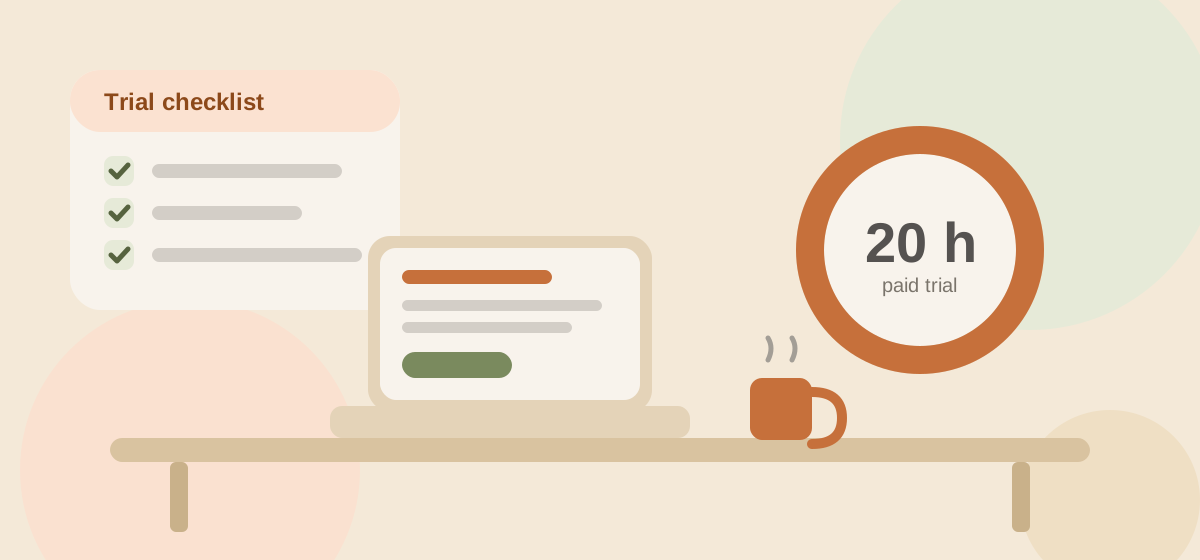
A virtual assistant trial period is a short, paid stretch of real work done before you commit to a longer agreement. Ours is 20 hours, and it follows five steps.
- Discovery call. A free 30-minute call maps the role, the tools and the hours you need.
- Shortlist and choice. Within 72 hours we send vetted candidates, and you interview them and pick one.
- Brief, access and advance payment. Your success manager helps set up tools, access and the first tasks, and you pay for the 20 hours in advance.
- Twenty paid hours. Your VA works on real tasks. You review the output and give feedback.
- Decision. Continue part time or full time on a renewable 12-month agreement, with a deposit at that point, or stop. Replacement is available if the fit is not right in the first month.
Steps 1 to 3 come from our how it works process and are free. The paid part starts when your VA starts working. For more on how candidates reach your shortlist, see how we vet virtual assistants. To look at profiles before a trial, see how Nomad's Talent Stage works. If you are new to the model, our guide on what a virtual assistant is covers the basics.
What does the paid 20-hour trial cover and cost?
The trial covers the first 20 hours of work. You pay for them in advance at the VA's current rate, which our pricing page estimates at $9 to $11 an hour, so about $180 to $220. The advance payment is not a deposit and is not refundable. There are no setup fees and no 12-month agreement is required to start.
Table 1: What the paid trial includes and how it is billed
| Item | How it works |
|---|---|
| Length | 20 hours of work, not a fixed number of days |
| Rate | The VA's current rate, estimated at $9 to $11 an hour |
| Estimated trial cost | About $180 to $220 |
| Contract needed to start | None. The renewable 12-month agreement applies only if you continue |
| Payment | Advance payment equal to 20 hours at the VA's current rate, paid before the trial starts. No setup fees |
| Refundable? | No. It pays for the 20 hours in advance and is not a deposit |
| When a deposit applies | Only if you commit the VA part time or full time after the trial. The amount differs for part time and full time |
| Replacement | If the fit is not right in the first month, we replace them at our cost |
Source: Nomad VAs pricing page and trial terms, read 5 November 2026. Rates are estimates, confirmed in writing after your discovery call.
Twenty hours is a quantity of work, so you control the calendar. At 4 hours a day the trial fits into 5 working days. At 2 hours a day it takes 10. Pick the pace that gives you time to review each day's output, because speed of feedback matters more than speed of finishing.
Paid trial vs free trial vs direct hire: which protects you most?
A paid trial protects you best when the work is real, because both sides have a reason to take it seriously. A free trial is usually shorter and lighter, and a direct hire front-loads cost and commitment. Table 2 compares the three on the points buyers ask about most.
Table 2: Three ways to test a new hire
| Question | Paid 20-hour trial | Free or short unpaid trial | Direct hire |
|---|---|---|---|
| Your cost to test | About $180 to $220 | $0, but often limited in scope | Recruiting cost plus wages from day one |
| Work is real? | Yes, real tasks with real output you keep | Often a sample or practice task | Yes, but you are already committed |
| Commitment to start | None | None | Employment or contract |
| Signal quality | High: 20 hours shows pace, quality and communication | Low to medium: short, easy to hide weak spots | Highest, but only after you have paid for it |
| If it fails | Stop and keep the output; the advance payment covered the hours and no deposit is due | Walk away | Notice periods and a second search |
Nomad VAs analysis, 5 November 2026, based on how each model is typically structured. Terms vary by provider, so confirm in writing.
The honest trade-off is cost. A free trial is cheaper on day one. A paid trial buys you 20 hours of evidence on work that matters to your business, and the output is yours either way. For a comparison of hiring models beyond trials, see our upcoming guide to virtual assistant vs freelancer vs agency.
How much risk does a paid trial remove?
It cuts your downside from thousands of dollars to roughly the price of a small purchase. If a direct hire fails after 20 hours, you have already paid the cost of finding them. If a trial fails, you have paid for 20 hours.
Table 3: Original calculation: cost of a failed hire after 20 hours of work
| Scenario | Calculation | Cost after 20 hours |
|---|---|---|
| Paid trial, low estimate | 20 hours x $9 | $180 |
| Paid trial, high estimate | 20 hours x $11 | $220 |
| U.S. administrative assistant, wages only | 20 hours x $23.23 | $465 |
| U.S. administrative assistant, with benefits | 20 hours x $33.19 ($23.23 divided by 0.70) | $664 |
| Failed direct hire after 20 hours | $5,475 cost per hire + $664 compensation | $6,139 |
Inputs: BLS median wage of $23.23 an hour (May 2025), benefits at 30.0% of compensation (June 2026), SHRM average cost per hire of $5,475 (2025). Nomad VAs analysis, 5 November 2026.
Two caveats keep this honest. First, a direct hire in the Philippines or elsewhere will have different wage and benefit costs than a U.S. administrative assistant, so use the comparison as an order of magnitude. Second, cost per hire is an average across many roles and is spent whether or not the hire stays. The point is the shape of the risk, not the exact dollar figure.
What does a good trial task look like?
A good trial task is real, bounded and reviewable. It should be work you actually need done, small enough to finish inside the trial and clear enough that you can say in advance what "done" looks like. Avoid test tasks you would never use, because they hide how someone handles your real tools and standards.
Table 4: Example trial tasks by role
| Role | Good trial task | Weak trial task |
|---|---|---|
| SEO VA | Audit 10 pages for titles, headings and internal links, and deliver a prioritized fix list | "Do some SEO for us" with no pages or goal |
| Social media VA | Schedule two weeks of approved posts and draft replies to comments | Invent a brand strategy from scratch |
| Customer support VA | Answer a batch of real, low-risk tickets using your help center and macros | Handle refunds and angry escalations on day one |
| Executive VA | Clear a week of inbox triage, schedule meetings and prepare a weekly summary | Open-ended "manage my life" |
Nomad VAs analysis, 5 November 2026. These are suggested examples, not a fixed program.
Write the brief before the trial starts. A one-page brief with the outcome, the inputs, the deadline and an example of a good result is enough. If you need a starting point, our free SOP and job description generator helps you turn a recurring task into a clear set of steps.
How should you run the 20 hours?
Run the trial as a short, structured onboarding with a review at each stage. Most disappointing trials fail because the brief was thin or feedback arrived too late, not because the person was wrong. Table 5 spreads the 20 hours across four phases.
Four phases, 20 paid hours
Tap a phase for what happens and what you do.
Setup and first task
Hours 1 to 4.
Core work
Hours 5 to 12.
Feedback loop
Hours 13 to 16.
Independent run
Hours 17 to 20.
Tap a card for detail.
Figure 3: The 20 trial hours in four phases
Table 5: A suggested pacing plan for 20 trial hours
| Phase | Hours | What happens | Your job |
|---|---|---|---|
| 1. Setup and first task | 1 to 4 | Tool access, one small task, questions asked | Share the brief and an example of a good result |
| 2. Core work | 5 to 12 | The main task, done at normal pace | Review within one working day and give specific feedback |
| 3. Feedback loop | 13 to 16 | Similar work, with your corrections applied | Check whether past feedback shows up in new output |
| 4. Independent run | 17 to 20 | A task with less guidance from you | Score the trial and decide |
Nomad VAs framework, 5 November 2026. An illustrative plan, not data from client trials.
Our guide to onboarding a virtual assistant goes deeper on the first two weeks. During the trial, give feedback in writing and keep it specific. "Make the summary shorter and lead with the decision" teaches more than "needs work".
How do you judge the results of the trial?
Judge the trial against criteria you wrote down before it started. Decide in advance what you will measure, score each item after the final hour and compare the total with a threshold you set early. That keeps one good or bad day from deciding the outcome.
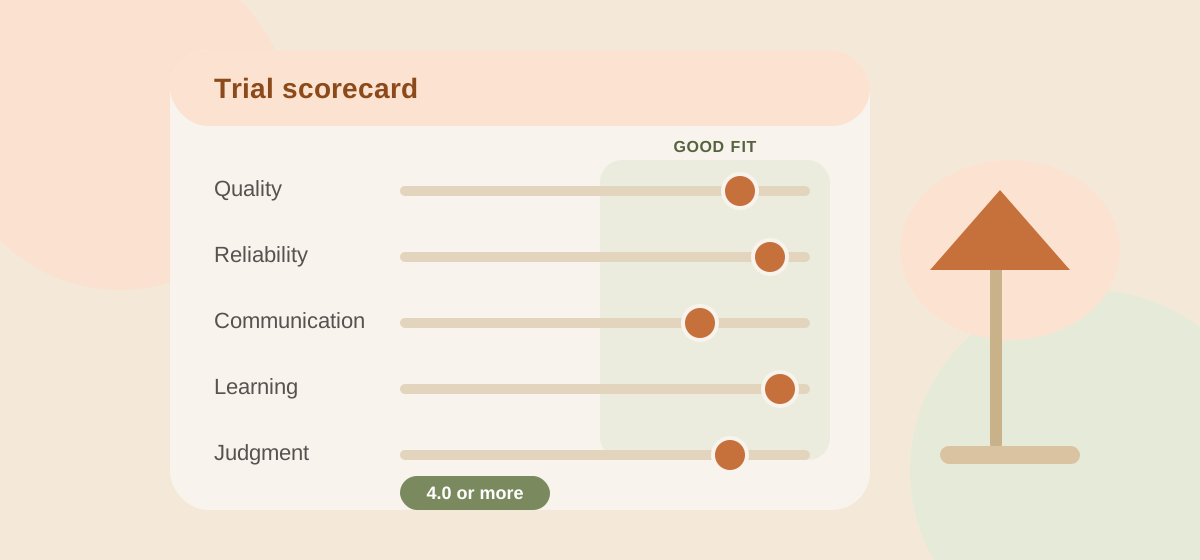
Table 6: A five-point trial scorecard (score each criterion from 1 to 5)
| Criterion | What to look at | Strong signal |
|---|---|---|
| Quality | Accuracy and finish of the output | Few corrections needed after the first review |
| Reliability | Deadlines, check-ins, follow-through | Delivers on time without chasing |
| Communication | Questions, updates, clarity in writing | Flags blockers early and writes clearly |
| Learning | Applies feedback to later work | The same mistake does not repeat |
| Judgment | Knows when to ask and when to proceed | Escalates the right things |
Nomad VAs framework, 5 November 2026. A suggested rubric, not a research-based standard.
A simple rule works well. An average of 4 or more is a clear continue. Between 3 and 3.9, extend with a sharper brief or ask for a different match. Below 3, stop. Notice that "learning" is scored separately: how someone responds to a correction predicts more than their first draft.
What happens if the trial fails or you want a different VA?
If the trial does not work, you stop. Your cost is the advance payment for the 20 hours, which is not refundable, and you keep the work produced. No deposit is due, because a deposit is asked only if you commit the VA part time or full time. If you want a different person, our replacement guarantee applies: if the fit is not right in the first month, we replace them at our cost, not yours.
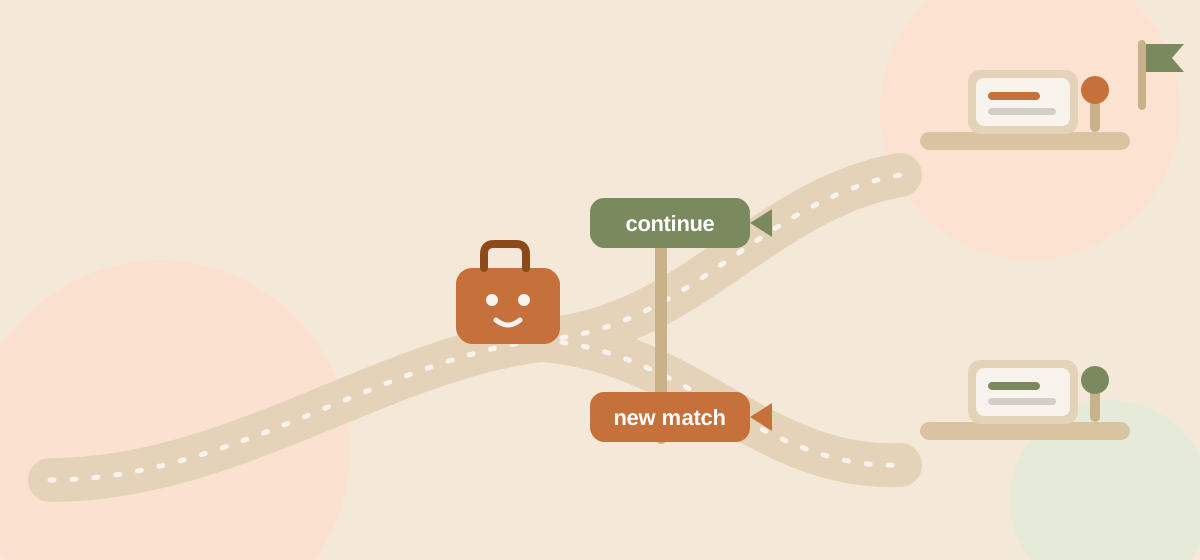
Keep the decision simple. If the scorecard says continue, you move to a renewable 12-month agreement with 30 days' notice to change or end it. If it says no, tell your success manager what you saw, because the notes help find a better match. Compare your options on our team page and in our guide to what a virtual assistant costs.
Why should a trial be paid at all?
A paid trial is fair to the person doing the work and gives you cleaner evidence. When someone does productive work for your business, the question of payment is not only an etiquette matter. The U.S. Department of Labor's Wage and Hour Division, for example, uses a primary beneficiary test for unpaid interns that looks at who benefits most from the arrangement. That rule is about internships, and laws differ by country, so check local rules before running any unpaid test of real work.
Paying also changes behavior. A paid trial treats the VA as a working professional, sets a clear scope and means the output belongs to you. It is also the reason we can ask you to review work properly: you have a stake in the result.
When is a paid trial not the right choice?
A paid trial is the wrong tool when you cannot give it what it needs. Three situations come up most often.
- You have no real work ready. If you cannot describe a task, the trial will measure your brief, not the person.
- You cannot review within about two working days. Slow feedback wastes hours and hides the learning signal.
- The role needs deep context first. Some work, such as regulated or highly technical tasks, cannot be judged in 20 hours. Use the trial to test communication and process, then plan a longer ramp.
If one of these applies, spend a week on the brief first. Our guide on signs you are ready to hire your first VA can help you check.
Frequently asked questions
How long is a virtual assistant trial period?
Our paid trial is 20 hours of work, not a fixed number of days. At 4 hours a day it fits into 5 working days, and at 2 hours a day it takes 10. You agree the pace with your success manager. Because the trial runs on real hours, a slower pace costs the same as a faster one. Our how it works page shows the full first two weeks.
Is the virtual assistant trial paid?
Yes. You pay in advance for the 20 hours at the VA's current rate, which our pricing page estimates at $9 to $11 an hour, so about $180 to $220. This advance payment is not a deposit and is not refundable, and no 12-month agreement is needed to start. You pay for real output you can keep. See our pricing for the current terms.
What happens if the trial does not work out?
You stop, and your cost is the advance payment for the 20 hours, which is not refundable. No deposit is due, because a deposit is asked only if you commit the VA part time or full time. If the fit is wrong in the first month of an agreement, we replace the person at our cost. Nomad VAs confirms the details in writing on your quote, so ask for them on your discovery call.
Can I keep the same VA after the trial?
Yes, that is the point of a trial. You evaluate the specialist you would be working with, and if the work meets your standard you move to a renewable 12-month agreement with that person and 30 days' notice to change or end it. If it is not a fit, you ask for a different match instead. Compare options on our team page.
Do I have to sign a 12-month contract to start the trial?
No. According to our pricing page, the first 20 hours need no 12-month agreement. The renewable 12-month agreement, with 30 days' notice, applies only once you decide to continue. That order lets you judge the work before you commit. Read the full terms at a glance on the pricing page before your call.
Is there a deposit for the paid 20-hour trial?
No. The trial uses an advance payment equal to 20 hours at the VA's current rate, about $180 to $220 at our estimate. It pays for the 20 hours in advance and is not refundable. A deposit is asked only if you commit the VA part time or full time after the trial, and its amount differs for each. To see what a month costs, use our guide to virtual assistant costs.
Sources
- U.S. Bureau of Labor Statistics, Occupational Outlook Handbook: Secretaries and Administrative Assistants (May 2025 pay data)
- U.S. Bureau of Labor Statistics, Employer Costs for Employee Compensation, June 2026 (released 9 September 2026)
- SHRM, 2025 Benchmarking Reports (15 October 2025; survey fielded 9 January to 3 March 2025)
- U.S. Department of Labor, Wage and Hour Division, Fact Sheet 71: Internship Programs Under the FLSA (updated January 2018)
- Nomad VAs, pricing and how it works pages (estimates, trial terms and process, as of 5 November 2026)
- First-party data: Nomad VAs trial cost model (Table 3), calculated 5 November 2026 from the sources above.