What Does an SEO VA Do? Tasks, Tools & Deliverables
A plain-English breakdown of the five things an SEO VA owns every week, the tools they work in, and what you should expect to see land in your inbox.
 Joshua Yanong
·
Published 8 September 2026
·
8 min read
Joshua Yanong
·
Published 8 September 2026
·
8 min read
Joshua is the founder of Nomad VAs. He personally vets every SEO VA the company places, and writes from what he sees working across real client engagements.
SEO is not a one-time project. Rankings shift as competitors publish, as Google updates its systems, and as your own pages age. Keeping up means doing the same careful work, research, edits, outreach, reporting, week after week. That steady grind is exactly what an SEO VA is built for.
Organic search remains one of the largest sources of website traffic for most businesses, a pattern search-industry publications like Search Engine Land track closely as AI Overviews and other search features reshape how people find answers. At the same time, the day-to-day execution work (research, on-page fixes, outreach, reporting) keeps growing in scope, which is exactly why more small teams delegate it rather than trying to squeeze it into an already-full week.
Below is a plain breakdown of what an SEO VA actually does day to day, the tools they work in, and the deliverables you should expect each week and month. If you want to see how the role maps to a hire, our page on how to hire an SEO VA shows the exact scope.
What does an SEO VA do day to day?
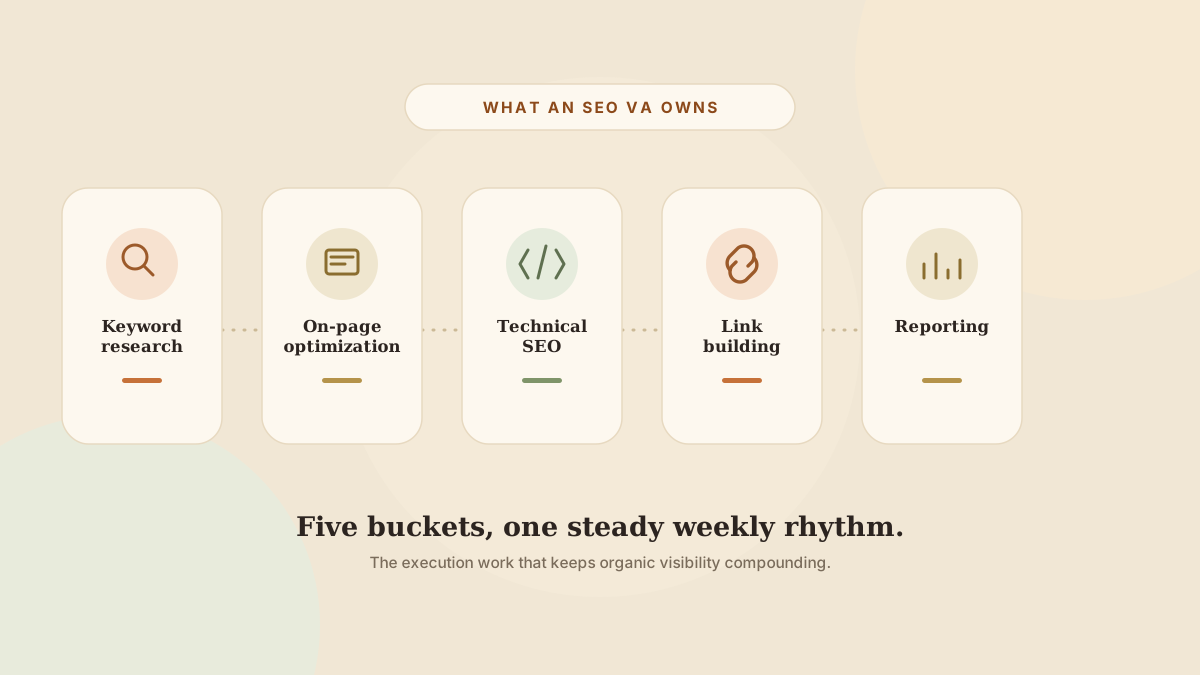
An SEO VA's work falls into five buckets: keyword research, on-page optimization, technical SEO, off-page (link building), and reporting. Most VAs touch several of these in a given week, following a plan set by you, an agency, or a senior strategist. Here is what each area covers.
| SEO area | What the VA actually does | How often |
|---|---|---|
| Keyword research | Finds and prioritizes terms by search volume, difficulty and intent; maps keywords to the right pages; spots content gaps against competitors. | Per new page or monthly |
| On-page optimization | Writes and refines title tags, meta descriptions and headings; adds internal links and image alt text; aligns each page to one focus keyword. | Weekly |
| Technical SEO | Runs site crawls, fixes broken links and redirect chains, checks indexing and Core Web Vitals in Search Console, keeps the sitemap clean. | Monthly + as flagged |
| Off-page / link building | Builds outreach prospect lists, sends guest-post and digital-PR pitches, tracks placements, and monitors the backlink profile for toxic links. | Weekly |
| Reporting | Pulls rankings, traffic, clicks and conversions into a dashboard; notes what moved and why; flags priorities for the next cycle. | Monthly |
1. Keyword research and mapping
This is the foundation. A good SEO VA does not just pull a list of high-volume terms. They weigh volume against difficulty and, most importantly, search intent. Rather than chasing a broad head term like "SEO services," they will surface specific, intent-rich phrases a smaller site can realistically win, then map each one to the page best suited to rank for it. Google's own guidance in Search Central stresses matching content to what people are actually searching for, and that mapping step is where a VA earns their keep.
2. On-page optimization
On-page is the most delegable, highest-frequency part of the job. A VA optimizes the elements Google reads on each page: the title tag and meta description, the H1 and supporting subheads, internal links, and image alt text, all built around a single focus keyword per page. This is repetitive, detail-heavy work that benefits enormously from a documented process and a consistent hand.
3. Technical SEO
Within reason, a trained SEO VA handles technical maintenance too. They will crawl the site to catch broken links, redirect loops, duplicate content and missing tags; monitor indexing and page-experience signals in Google Search Console; and keep the XML sitemap and robots file tidy. Heavy lifting (server-level fixes, log-file analysis, or a full site migration) is where you would escalate to a senior technical SEO or developer.
4. Off-page SEO and link building
Link building is outreach at heart, which makes it a natural fit for a VA. They research relevant, credible prospects, run guest-post and digital-PR campaigns, personalize and send pitches, track responses, and watch the backlink profile for spammy links that need disavowing. It is persistent, list-driven work, again, the kind that rewards consistency over bursts.
5. Reporting and analytics
Finally, an SEO VA closes the loop by turning raw data into a readable monthly report: keyword movements, organic traffic, click-through rate, and conversions, usually assembled in a dashboard so you can see progress at a glance. The best reports do not just show numbers. They say what changed, why, and what to prioritize next.

What tools does an SEO VA use?
An experienced SEO VA is comfortable across a standard toolkit. You do not need every tool on this list, most small teams run two or three, but knowing the categories helps you understand what a VA is working with and where your tool budget goes.
| Job to be done | Common tools | What it's for |
|---|---|---|
| Performance & indexing | Google Search Console, Google Analytics 4 | Free, first-party data on queries, clicks, indexing and traffic. |
| Keyword & competitor research | Ahrefs, Semrush | Search volume, keyword difficulty, backlink and competitor analysis. |
| Technical crawls | Screaming Frog, Sitebulb | Site-wide audits for broken links, redirects, duplicate tags. |
| On-page checks | Yoast, Rank Math (CMS plugins) | Real-time on-page and readability guidance inside the CMS. |
| Reporting | Looker Studio, Google Sheets | Pulling data into a shareable monthly dashboard. |
Two of the most valuable tools are free: Google Search Console and Google Analytics 4. A capable VA lives in both. The paid research suites (Ahrefs and Semrush both publish extensive educational material on how their metrics work) mainly speed up keyword and backlink research. They do not replace judgment.
SEO VA vs. SEO specialist: what's the difference?
People often use "SEO VA" and "SEO specialist" interchangeably, but the distinction is worth understanding before you hire. The short version: a specialist sets direction, a VA executes it consistently. Many lean teams pair the two, or use a VA to run a plan the founder or an agency defined.
| Dimension | SEO VA | SEO specialist |
|---|---|---|
| Primary focus | Execution of the plan | Strategy and diagnosis |
| Typical work | Research, on-page, outreach, reporting | Roadmap, audits, judgment calls, forecasting |
| Best for | Ongoing, repeatable tasks | Direction-setting and complex problems |
| Relative cost | Lower, offshore or freelance rates | Higher, senior or agency rates |
For most small businesses, the practical move is to get a clear plan in place, then hand the weekly execution to a VA who follows it. If you are weighing that against a full agency retainer, our comparison of an SEO VA versus an SEO agency lays out the trade-offs.
What deliverables should you expect?
A good working relationship is defined by clear outputs. Below is a realistic cadence of what a well-run SEO VA engagement produces. Set these expectations up front, ideally with a simple SOP, and you will get consistent quality instead of guesswork.
| Cadence | Deliverables |
|---|---|
| Weekly | On-page optimizations completed; internal links added; outreach emails sent; a short progress note. |
| Monthly | Keyword ranking report; organic traffic and conversion summary; technical audit findings; a prioritized to-do list for the next month. |
| Quarterly | Content-gap review; backlink profile health check; refreshed keyword map; recommendations for the next quarter. |
Two things make these deliverables reliable. First, documented SOPs so the same task is done the same way every time. Second, clear KPIs (pages optimized per week, outreach volume, or ranking targets) so "done" is never ambiguous. That structure is what turns an SEO VA from a helping hand into a genuine growth lever.
Want to see which of these you should hand off first? Our guide on the SEO tasks you can delegate to a virtual assistant breaks it down task by task, and you can browse the roles across our full specialist lineup on the browse the roles page. If you want the fuller case for building the role out, we've covered why hire an SEO VA in 2026 separately.
Frequently asked questions
What tasks can I delegate to an SEO VA?
Almost any repeatable, execution-level task: keyword research and mapping, on-page optimization (titles, metas, headings, internal links, alt text), technical checks (broken links, redirects, sitemap and Search Console monitoring), link-building outreach, content briefs, and monthly reporting. Most owners keep high-level strategy and final sign-off in-house and hand the ongoing execution to the VA.
What tools do SEO VAs use?
A typical SEO VA works in Google Search Console and Google Analytics 4 for performance data, a research suite such as Ahrefs or Semrush for keywords and backlinks, a crawler like Screaming Frog for technical audits, and a CMS plugin such as Yoast for on-page checks. Reporting is usually assembled in Looker Studio or Google Sheets.
What is the difference between an SEO VA and an SEO specialist?
Mostly scope and seniority. A specialist owns strategy: the roadmap, the diagnosis, the judgment calls. A VA focuses on executing that plan consistently: research, on-page edits, outreach and reporting. Many small teams use a VA to run a strategy set by a specialist, an agency, or the founder.
Can an SEO VA do technical SEO?
Yes, within limits. A trained SEO VA can run crawls, flag broken links and redirect chains, monitor Core Web Vitals and indexing in Search Console, and fix on-page technical items in the CMS. Deeper work, server configuration, log-file analysis, or large-scale migrations, is usually escalated to a senior technical SEO or a developer.
How many hours a week does an SEO VA need?
It depends on the size of the site and the ambition of the plan. A single small-business site on a steady maintenance plan can be handled in roughly 10 to 20 hours a week. A larger site with an active content and link-building program, or several sites at once, usually justifies a full-time (about 40 hours per week) VA.
Sources
- Search Engine Land, ongoing search-industry news and channel research
- Google Search Central, SEO Starter Guide