The Future of Hiring: Direct Hire vs. Contract-to-Hire vs. Temporary Staffing
Different roles demand different risks. The smartest teams balance speed, commitment, and total talent cost, instead of forcing every hire through the same model.
 Joshua Yanong
·
Published 29 August 2026
·
Updated 28 September 2026
·
11 min read
Joshua Yanong
·
Published 29 August 2026
·
Updated 28 September 2026
·
11 min read
Joshua is the founder of Nomad VAs. He personally vets every SEO VA the company places, and writes from what he sees working across real client engagements.
Hiring is no longer a one-size-fits-all decision. A senior engineer who will own your core product for the next five years and a specialist you need for a six-week campaign are not the same problem, yet many companies still run every role through the same slow, expensive full-time pipeline. That mismatch is where budgets bleed and timelines slip.
The global labour market is being reshaped fast. The World Economic Forum estimates that around 170 million new jobs will be created this decade, while roughly 39% of workers' core skills are expected to change by 2030. In a market moving that quickly, how you hire matters as much as who you hire. This guide breaks down the three dominant staffing models, when each one wins, and how to combine them into a flexible talent strategy.
What are the three main hiring models?
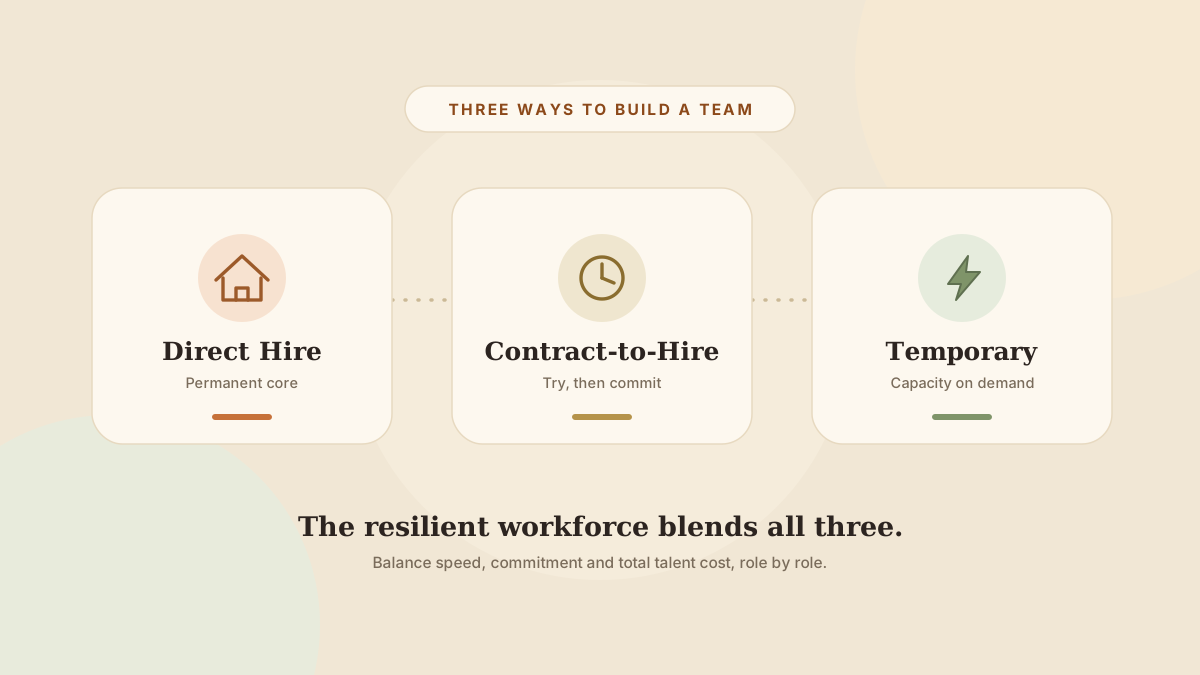
There are three primary ways to bring talent onto a team, each solving a different business problem:
- Direct hire. You recruit an employee straight onto your permanent payroll. Best for long-term, high-commitment roles where culture fit and retention matter most.
- Contract-to-hire. A worker joins on a fixed-term contract (typically three to six months) with the option to convert to a permanent employee if the fit is right. Best when you want to "try before you buy."
- Temporary staffing. A staffing partner supplies workers for short-term or project-based needs and funds the payroll. Best for speed, seasonal spikes, and specialised, time-boxed work.
The difference isn't just administrative. Each model swaps a different set of risks: upfront cost against ongoing cost, speed against commitment, flexibility against continuity.
Upfront cost vs. long-term value: how the money actually works
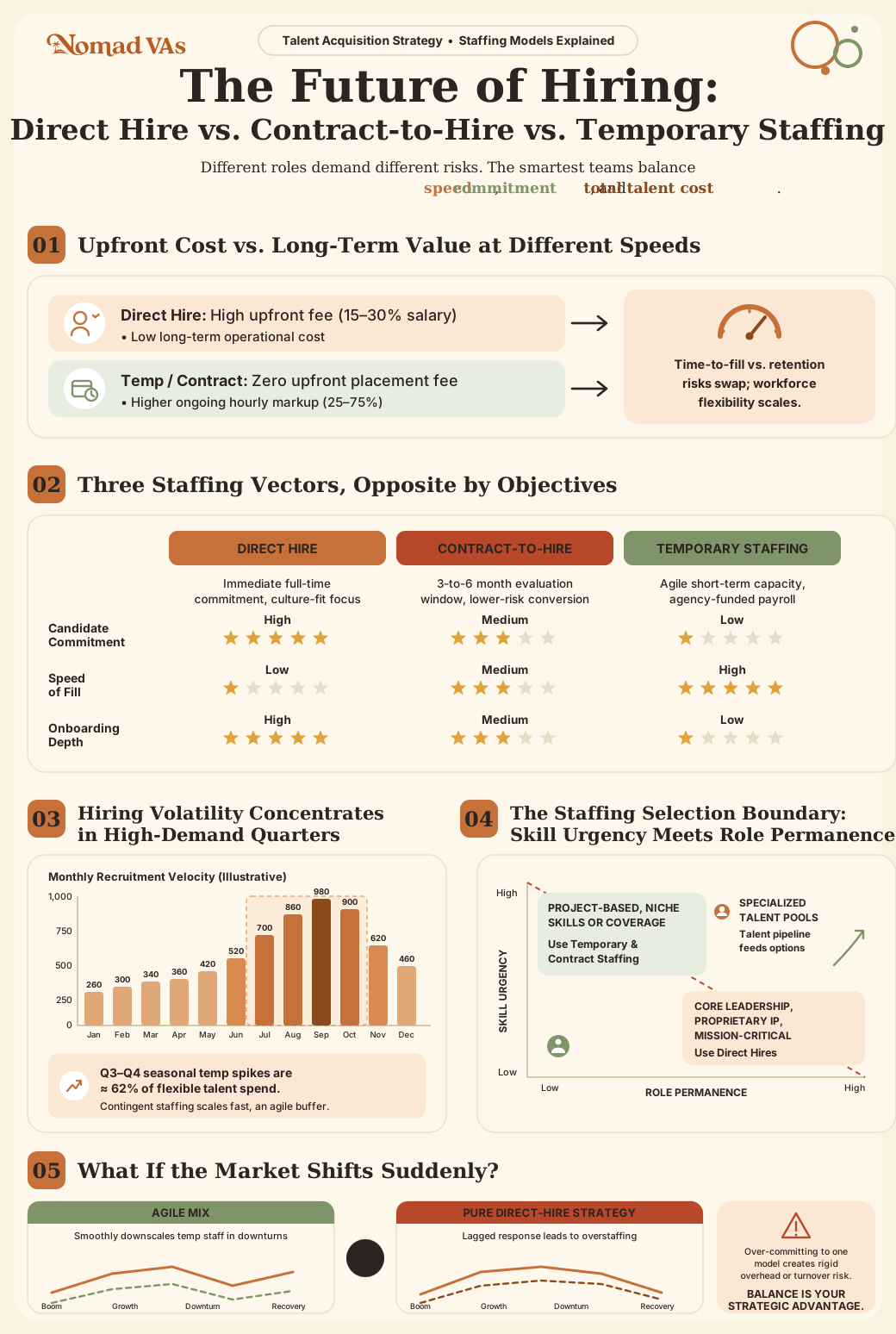
The cost structures of these models are almost mirror images of each other. Direct hire front-loads the cost: you pay a large one-time fee to secure someone, then enjoy low ongoing operational cost. Temporary and contract staffing invert that: no upfront placement fee, but a higher ongoing hourly markup that covers payroll taxes, insurance, compliance, and the agency's service.
| Cost factor | Direct hire | Temporary / contract staffing |
|---|---|---|
| Upfront placement fee | High, typically 15–30% of first-year salary | Zero upfront placement fee |
| Ongoing cost | Low long-term operational cost | Higher hourly markup, roughly 25–75% over base pay |
| Who employs the worker | You (your payroll) | The staffing agency (agency-funded payroll) |
| Best when | The role is permanent and continuous | The need is temporary, seasonal, or project-based |
These ranges are widely reported across the staffing industry and match the figures in the infographic accompanying this article. A direct-hire placement fee of 15–30% of first-year salary and a temporary markup of 25–75% are standard reference points; the Society for Human Resource Management (SHRM) notes that staffing markups on labour rates can climb toward the higher end of that band for specialised or hard-to-fill roles.
The practical takeaway: time-to-fill and retention risk swap places depending on the model. Direct hire minimises long-run cost but is slow and risky if the person doesn't stay. Temporary staffing minimises time-to-fill and lets your workforce flex up and down, but you pay a premium for that agility. Neither is "cheaper" in the abstract; the right answer depends entirely on how long you need the role filled.
Direct hire vs. contract-to-hire vs. temporary staffing: side-by-side comparison
Beyond cost, the three models behave very differently on the factors that decide whether a hire succeeds: how committed the worker is, how fast you can fill the seat, and how deeply they get onboarded into your business.
| Factor | Direct hire | Contract-to-hire | Temporary staffing |
|---|---|---|---|
| Core objective | Immediate full-time commitment, culture-fit focus | 3–6 month evaluation window, lower-risk conversion | Agile short-term capacity, agency-funded payroll |
| Candidate commitment | High | Medium | Low |
| Speed of fill | Low | Medium | High |
| Onboarding depth | High | Medium | Low |
| In one line | Built for the long run: invest deep, grow together | Evaluate first, commit with confidence | Flexible by design: capacity on demand |
Read the table as a set of trade-offs rather than a scoreboard. A "low" speed of fill for direct hire isn't a flaw; it reflects the deeper vetting and courtship a permanent hire deserves. A "low" onboarding depth for temporary staffing is a feature: the whole point is plugging in ready-to-work specialists without a long ramp. Problems only appear when you use the wrong model for the job: hiring a temp for a role that needs deep institutional knowledge, or running a slow direct-hire search for work you needed done last week.
This is exactly why a pre-vetted virtual assistant model has become so popular for growing companies: it delivers the speed and flexibility of temporary staffing while still matching you with specialists who have done the work before.

When should you use each hiring model?
The clearest way to choose is to plot a role against two questions: How urgent and specialised is the skill? and How permanent is the role? These two axes, skill urgency and role permanence, draw a natural boundary between the models.
| Skill urgency | Role permanence | Recommended model | Example roles |
|---|---|---|---|
| High (time-critical) | Low (short-term / project) | Temporary & contract staffing | Campaign paid ads specialists, seasonal customer support (CSR) agents, one-off content writing sprints |
| High (niche / specialised) | Medium | Contract-to-hire | SEO virtual assistants, social media managers, outreach specialists you may want to keep |
| Moderate | High (core / ongoing) | Direct hire | Core leadership, proprietary IP owners, mission-critical operators |
| Specialised, recurring | Ongoing support | Flexible specialist staffing | Executive assistants, healthcare VAs, real estate VAs |
Use temporary and contract staffing for project-based work, niche skills, and coverage needs: anything with a defined end point or an uncertain future. Use direct hire for core leadership, roles that touch proprietary intellectual property, and mission-critical positions where continuity is non-negotiable. And treat your specialised, recurring needs as a talent pipeline: a great contract specialist is often the lowest-risk source of your next permanent hire, because you've already seen the work.
For most day-to-day operational roles (the marketing, admin, support, and specialist work that keeps a business running), flexible staffing hits the sweet spot. You can browse the full range of specialist virtual assistant services to see which functions are the easiest to delegate first.
Why hiring volatility concentrates in a few quarters
Hiring demand is rarely flat across the year. It clusters heavily. Modelling monthly recruitment velocity for a typical growth-stage company shows a pronounced surge through the second half of the year, when campaigns, seasonal demand, and year-end pushes collide.
| Quarter | Illustrative hiring volume (indexed) | Pattern |
|---|---|---|
| Q1 (Jan–Mar) | 280 to 340 | Slow, steady baseline |
| Q2 (Apr–Jun) | 360 to 520 | Gradual ramp |
| Q3 (Jul–Sep) | 700 to 980 | Sharp seasonal peak |
| Q4 (Oct–Dec) | 900 to 460 | High, then fast wind-down |
In this illustrative model, Q3 to Q4 seasonal spikes account for roughly 62% of flexible talent spend. That concentration is the single strongest argument for keeping a contingent layer in your workforce. Contingent staffing scales up and down fast, creating an agile talent buffer that absorbs demand peaks without leaving you overstaffed in January.
This isn't a niche pattern. Temporary help services have been one of the fastest-recovering categories in the labour market, and as reported by Fortune, temporary help services added among the highest number of jobs of any U.S. industry in 2026, reflecting how many employers now treat flexible labour as a permanent part of their strategy rather than a stopgap. The U.S. Bureau of Labor Statistics counted about 6.9 million contingent workers in its most recent survey, roughly 4.3% of employment, up from 3.8% a few years earlier.
What happens when the market shifts suddenly?
The real test of a workforce strategy isn't a stable year; it's a sudden change. Compare two companies heading into a downturn.
The agile mix, a core of permanent employees surrounded by a flexible contract-and-temp layer, downscales smoothly. When demand falls, the contingent portion contracts first, protecting the core team and the balance sheet. When recovery comes, it scales back up just as fast.
The pure direct-hire strategy reacts with a lag. Because every role sits on permanent payroll, the workforce can't shrink quickly without painful layoffs, so companies carry overstaffing costs deep into the downturn. The response is slow, expensive, and demoralising.
The lesson is simple: over-committing to a single hiring model creates rigid overhead in a downturn or high turnover risk in a boom. Balance is the strategic advantage. This matters even more given how much disruption sits ahead: the World Economic Forum projects that roughly 22% of jobs will undergo structural change by 2030. Workforces built for one economic weather pattern will struggle in another.
How to build a balanced staffing strategy
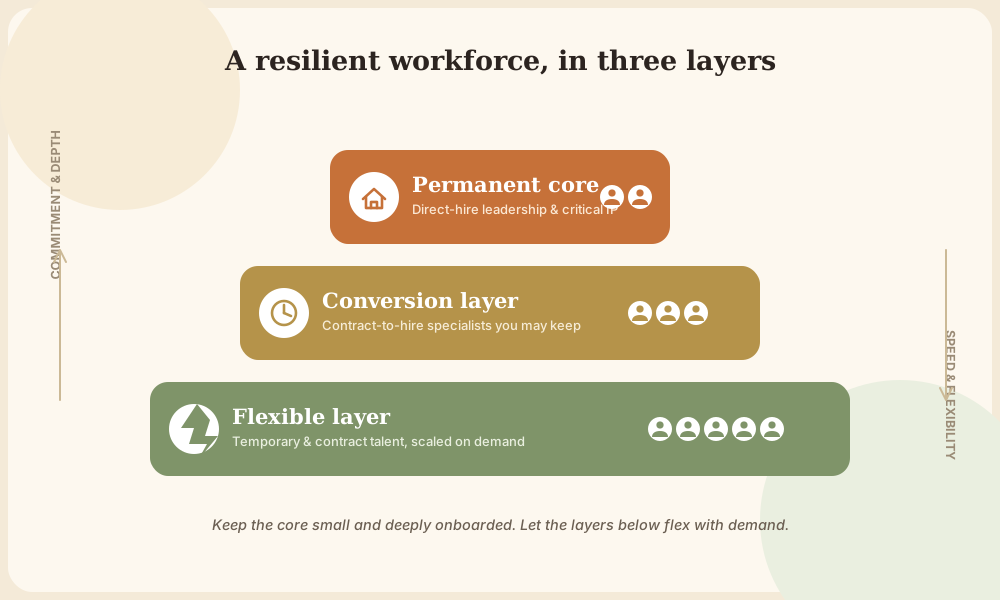
A resilient model usually looks like three layers:
- A permanent core. Direct-hire your leadership, culture-carriers, and anyone who owns critical IP or long-term customer relationships. Keep this layer small, senior, and deeply onboarded.
- A conversion layer. Use contract-to-hire for promising specialists you might want to keep. The three-to-six-month window lets you evaluate real work before extending a permanent offer, a far better signal than any interview.
- A flexible layer. Staff your seasonal peaks, project work, and specialised functions with temporary and contract talent that can scale on demand.
The financial logic is compelling. With average cost-per-hire around $4,700 and a typical time-to-fill of roughly 44 days according to SHRM benchmarking, every avoidable permanent hire, and every week a critical seat sits empty, carries real cost. A flexible layer lets you get work moving in days instead of weeks, and only convert to permanent once you're sure.
For most companies, the fastest way to build that flexible layer is with pre-vetted specialists. Nomad VAs matches you with the top few percent of applicants across disciplines, from SEO and social to healthcare, real estate, and executive support, backed by a refundable service deposit and a renewable 12-month agreement you can cancel with 30 days' notice. You can see how our pricing works or book a discovery call to map the right model for a specific role.
Frequently asked questions
What is the difference between direct hire and contract-to-hire?
Direct hire places a worker on your permanent payroll immediately, usually in exchange for a one-time placement fee of 15–30% of first-year salary. Contract-to-hire starts the worker on a fixed-term contract, typically three to six months, with the option to convert them to a permanent employee if the fit is right. Contract-to-hire lowers the risk of a bad permanent hire because you evaluate real work before committing.
Is temporary staffing cheaper than direct hire?
It depends on how long you need the role filled. Temporary staffing has no upfront placement fee but carries a higher ongoing hourly markup (roughly 25–75% over base pay). For short-term or project-based needs, that usually works out cheaper and far more flexible. For a permanent, full-time role you'll keep for years, direct hire's low long-term operational cost typically wins.
Who pays and employs a temporary worker?
With temporary staffing, the staffing agency is the legal employer. The agency funds payroll and handles employment taxes, insurance, workers' compensation, and compliance, then bills you a single hourly rate. That's a core reason companies use temporary staffing to move quickly without taking on employer administrative burden.
When should a company use temporary or contract staffing instead of direct hire?
Use flexible staffing when the skill is urgent or niche and the role is short-term, seasonal, or project-based, for example campaign paid ads, seasonal customer support, or a one-off content sprint. Reserve direct hire for core leadership, roles that touch proprietary IP, and mission-critical positions where long-term continuity matters most.
What is contract-to-hire and why is it lower risk?
Contract-to-hire is a hybrid model where a worker joins on a fixed-term contract with a built-in path to permanent employment. It's lower risk because both sides get an extended trial: you see genuine performance over months rather than relying on interviews, and you only extend a permanent offer once the fit is proven.
How do I build a workforce that can handle sudden market changes?
Blend all three models. Keep a small permanent core via direct hire, use contract-to-hire as a conversion pipeline for specialists you may want to keep, and staff seasonal and project peaks with temporary talent that scales on demand. This "agile mix" downscales smoothly in downturns and ramps quickly in a recovery, avoiding both rigid overhead and high turnover.
What roles are best to start with when delegating to flexible staff?
Operational and specialist functions are usually the easiest first delegations: SEO, social media management, customer support, content writing, paid ads, outreach, and executive assistance. These roles have clear deliverables and don't require deep institutional knowledge, so a vetted specialist can plug in quickly. Explore the full range of services to prioritise where flexible staffing will free up the most time.
Data note: Cost, markup, and hiring-velocity figures in this article are illustrative industry reference ranges drawn from the accompanying infographic and corroborated by public sources including the U.S. Bureau of Labor Statistics, the Society for Human Resource Management, and the World Economic Forum. Actual fees, markups, and timelines vary by industry, role, region, and market conditions.